Shared hosting works fine, right up until it doesn’t. For a lot of Vietnamese MSMEs, that moment arrives during a flash sale, a viral post, or just a slow, unglamorous climb in traffic. That’s usually when someone on the team starts searching for VPS hosting in Vietnam options at 11pm.
But before you decide on a VPS hosting provider, you need to know what it actually solves. You have to know when it’s worth the switch, and how providers such as OVHcloud to smaller domestic names like BKHOST, stack up on the things that matter to a growing business.
Why VPS Hosting Is Becoming Relevant to Vietnamese MSMEs
Vietnam’s ecommerce and SaaS scene has been growing fast, and a lot of that growth is happening on infrastructure that wasn’t built for it.
Shared hosting pools CPU, RAM, and IO across dozens (sometimes hundreds) of accounts on one physical server. That’s fine for a brochure site. It’s not fine for a checkout page during a promotion.
A VPS changes the arrangement. You still share physical hardware, but your slice of CPU, RAM, and storage is yours, walled off through virtualization. No noisy neighbor eating your resources at the worst possible moment.
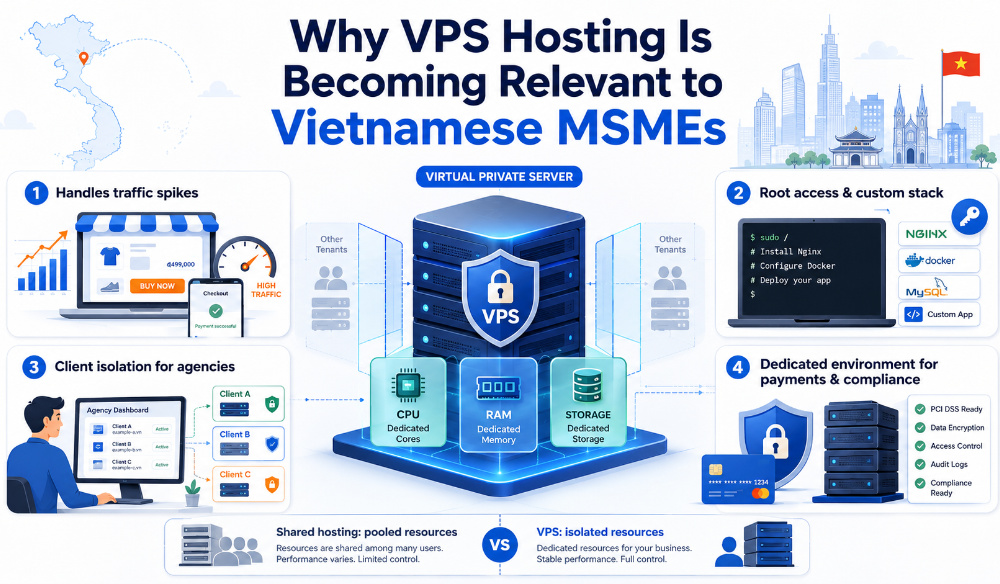
For MSMEs specifically, a few forces are pushing this shift:
● Ecommerce traffic is spikier and less forgiving of downtime than it used to be.
● SaaS and app-based startups need root access to install their own stack, which shared hosting simply doesn’t allow.
● Agencies managing multiple client sites need isolation, so one client’s traffic spike doesn’t take down five others.
● Payment gateways and compliance requirements increasingly expect a dedicated, auditable environment.
None of this means every small business needs a VPS today. But the businesses that outgrow shared hosting tend to know it, and the ones that don’t are usually the ones still guessing.
When Should an MSME Move to VPS?
There’s no universal traffic number that triggers the move. It’s more about symptoms. Consider VPS hosting if:
● Your site slows down noticeably during traffic spikes, even modest ones.
● You’ve hit resource caps on shared hosting (CPU throttling, memory limits) more than once.
● You need to install custom software, run background jobs, or configure your own server environment.
● You’re running a store, booking system, or SaaS product where downtime has a direct revenue cost.
● You want predictable performance rather than “best effort” shared resources.
If none of that sounds familiar yet, shared hosting is probably still doing its job. And if your business has genuinely outgrown a VPS, heavy compute, large teams, strict compliance, a dedicated server or cloud infrastructure setup may be the more logical next step, not VPS.
Best VPS Hosting Providers for Vietnamese MSMEs
The providers below were evaluated against five criteria that map directly to what an MSME actually cares about: performance (compute, storage, network), scalability (can you grow without migrating everything), security (backups, DDoS protection, isolation), pricing and value (not just the first-year discount), and support (channels, response times, and whether you’re on your own or not).
A mix of international infrastructure providers and Vietnam-focused hosts is included, since the right fit often depends on where your customers actually are.
1. OVHcloud
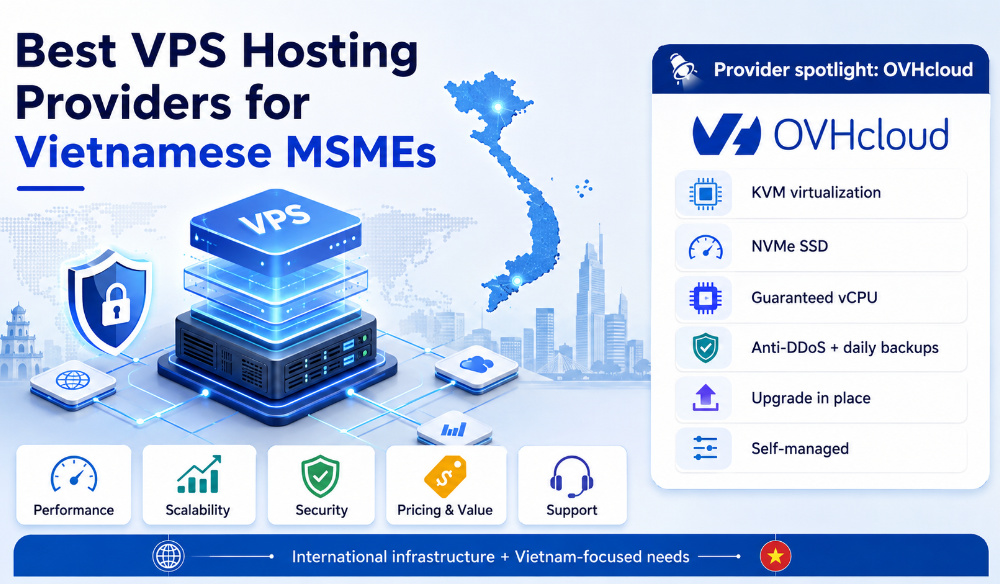
Performance: OVHcloud’s VPS hosting lineup runs on KVM virtualization with NVMe SSD on most tiers, guaranteed vCPU allocation, and IPv4/IPv6 from the start. OVHcloud is a French-headquartered operator running roughly 46 data centres across four continents, and its VPS line spans budget-conscious self-hosters up through small business use. That range is the point: an MSME can start small and stay on the same platform as it grows.
Scalability: OVHcloud VPS plans can be upgraded in place, without needing to transfer data or rebuild the server. It works in one direction only: downgrading to a smaller plan isn’t a simple switch, it means cancelling the current plan and ordering a new one. Worth keeping in mind when picking a starting tier, since sizing down later is more of a migration than a click.
Security: Free always-on anti-DDoS protection and daily backups are included, along with IPv4 and IPv6 from boot. Solid baseline coverage without needing to buy a separate security add-on.
Pricing & Value: Entry pricing on the Asia site starts from US$ 4.54 ex. GST per month, scaling up through higher tiers. One thing to check is the bandwidth regulations for the Asia-Pacific region. Prices also moved recently, the lowest VPS tier increased by roughly 30% in a March 2026 repricing, so it’s worth confirming renewal rates in the account manager, not just the landing page.
Support: OVHcloud is largely self-managed. Documentation is thorough, but there’s no hand-holding layer for businesses that want someone else to run the server for them.
Best suited for: Ecommerce sites, SaaS teams, and agencies that are comfortable managing their own server and want a scalable, internationally-distributed infrastructure provider.
2. VinaHost
Performance: VinaHost’s VPS tiers span CheapSSD, ProSSD, and NVMe options, using SSD RAID 10 storage for faster read/write speeds, with OS support for Ubuntu, CentOS, Debian, AlmaLinux, and Rocky Linux. That’s a reasonable spread for everything from a small storefront to a heavier application.
Scalability: Higher-tier plans allow customers to register up to nine additional IPs, and certain plans support a custom IP range after activation. Upgrading generally means moving to a higher plan tier rather than a true in-place resize.
Security: Free IPv6 and SSL are included, along with unmetered data transfer, though backups are a paid add-on, one copy per week, with three weeks of backup history retained. Businesses that need daily backups should factor that cost in separately.
Pricing & Value: CheapSSD VPS starts around $3.07/month, ProSSD from $4.89/month, and NVMe VPS from $8.08/month. Attractive entry pricing, but note the 10% VAT isn’t included in headline prices, and full server administration is a separate paid service if you don’t want to manage it yourself.
Support: 24/7 technical support is available via email, livechat, and hotline, with a stated maximum response time of 15 minutes. Vietnamese-language support is a genuine advantage for local teams who don’t want to troubleshoot server issues in a second language.
Best suited for: Vietnamese MSMEs and small ecommerce operations that want local-language support without paying international pricing.
3. TinoHost
Performance: TinoHost has built its infrastructure around NVMe storage, positioning it as a faster alternative to older SSD-based plans. It’s a younger brand, but has scaled quickly within the domestic market.
Scalability: Plans are tiered by resource level, and moving up generally means upgrading to a higher package rather than granular resource adjustment, typical of most Vietnamese local hosts.
Security: Weekly automated backups are standard across hosting plans, with daily backups specifically for Cloud VPS customers, plus free SSL bundled in.
Pricing & Value: VPS plans start from roughly US$ 3.25 per month, which puts it firmly in budget territory for local buyers. As with most VND-priced hosts, promotional first-term pricing is common, so it’s worth checking the renewal rate before signing up long-term.
Support: TinoHost advertises 24/7 support with a five-minute response commitment, which is aggressive compared to most competitors in this list, worth testing against real tickets rather than taking at face value.
Best suited for: Individuals and small teams running lean projects or early-stage ecommerce sites who want low prices without giving up responsiveness entirely.
4. Bluehost
Performance: Bluehost’s VPS plans run on AMD EPYC processors, and the brand’s strength has historically been in beginner-friendly shared and WordPress hosting, with VPS positioned as the natural next step up.
Scalability: Bluehost is built to let businesses grow from shared hosting into VPS without a full migration, you keep your files, your site, and your existing setup. That continuity is a genuine advantage for a business that started on shared hosting and doesn’t want a disruptive cutover.
Security: Standard security tooling is included, though Bluehost’s infrastructure and support are oriented toward US and global audiences rather than APAC-specific concerns.
Pricing & Value: Bluehost VPS plans typically around US$ 4.69 per month. That’s a latency consideration if most of your customers are browsing from within Vietnam or Southeast Asia; it’s worth testing actual load times before committing.
Support: Bluehost is positioned as an affordable managed VPS hosting option, which suits businesses that want some hand-holding but aren’t ready for premium managed pricing.
Best suited for: Businesses already on Bluehost shared hosting that want a low-friction upgrade path, provided latency to Vietnamese users is checked first.
5. Scala Hosting
Performance: ScalaHosting uses KVM virtualization with dedicated CPU and RAM resources, and NVMe storage across its Cloud VPS platform. It also runs its own control panel, SPanel, built as an alternative to licensed cPanel.
Scalability: Users can also upgrade to AWS-backed infrastructure while continuing to manage servers through ScalaHosting’s own management stack, a fairly unusual hybrid approach that gives room to grow without a full platform switch.
Security: SPanel includes SShield, described as real-time security protection, along with automated backups. That’s a meaningfully more built-in security posture than most unmanaged VPS options.
Pricing & Value: Sits around US$ 14.95 per month for entry-level managed cloud VPS configurations, generally cheaper than premium managed players like Liquid Web but pricier than bare-bones unmanaged VPS from Hostwinds or OVHcloud’s entry tiers.
Support: This is Scala’s clearest differentiator. Free site migration is handled by their own technical staff, which removes a lot of the friction MSMEs worry about when leaving shared hosting.
Best suited for: Businesses that want managed VPS without enterprise pricing, and would rather pay a bit more than deal with server administration themselves.
6. TENTEN.VN
Performance: TENTEN has over a decade of operation in Vietnam, serving nearly 200,000 individual and corporate customers, and operates as part of the GMO-Z.com RUNSYSTEM group, giving it backing from a larger regional hosting network.
Scalability: As a domestic provider, plan upgrades tend to follow the standard tier-jump model rather than granular resource scaling, similar to other local Vietnamese hosts.
Security: Standard local hosting security practices apply, backups and basic protections are included, though specifics should be checked directly against the current plan sheet, as details change with promotions.
Pricing & Value: At at starting price of US$ 11.09 per month, TENTEN is generally positioned as a mid-range option.
Support: TENTEN’s stated philosophy centers on customer satisfaction, and Vietnamese-language support is a natural fit for domestic teams.
Best suited for: Local Vietnamese businesses that prefer working with an established domestic provider backed by a larger Japanese hosting group.
7. Liquid Web
Performance: Liquid Web positions its VPS tier toward business-critical workloads rather than budget hosting, with an emphasis on consistent performance under load.
Scalability: Liquid Web’s plans seem more suited for enterprise or fast-growing SMEs compared to lighter competitors, the infrastructure is built with headroom for growth in mind.
Security: Enterprise-grade security tooling and monitoring come standard, in line with its premium market position.
Pricing & Value: Liquid Web’s entry-level cloud VPS plans start at US$ 5.00 per month. Liquid Web is known for both entry-level and premium managed hosting aimed at businesses and high-traffic websites, with managed VPS plans that include strong support and enterprise-grade infrastructure. Businesses should weigh the added management cost against what they’d otherwise spend hiring in-house server expertise, for some, it nets out cheaper.
Support: Consistently rated among the strongest in the managed hosting space, with support depth that goes well beyond ticket queues.
Best suited for: Businesses running revenue-critical sites or applications that can’t tolerate downtime and are willing to pay for premium managed support.
8. Hostwinds
Performance: Hostwinds offers both managed and unmanaged VPS tiers with flexible resource configurations, letting businesses pick a resource profile that matches their workload rather than a fixed bundle.
Scalability: Plans scale across a wide range of CPU, RAM, and storage combinations, making it relatively easy to size up as a site grows.
Security: Hostwinds is built around a 99.9999% uptime guarantee, and standard DDoS protection is included across VPS tiers.
Pricing & Value: Starting at US$ 4.99 per month for unmanaged Linux server configurations, with managed options costing more, a fairly standard trade-off across the industry.
Support: Available across both managed and unmanaged tiers, giving businesses the choice of self-administering or paying for hands-on help.
Best suited for: Growing businesses that want flexibility to choose their exact resource mix rather than fitting into predefined plan tiers.
9. BKHOST
Performance: BKHOST’s infrastructure claims website access speeds up to 200 times faster than traditional HDDs, with servers optimized using Apache, NGINX, PHP-FPM, and MySQL/MariaDB, plus caching via Varnish, Memcached, and Redis. That’s a fairly complete performance stack for a local provider.
Scalability: As with most domestic hosts, scaling generally means moving to a higher plan tier rather than adjusting resources incrementally.
Security: A 99.9% uptime guarantee is offered, and the provider maintains a public documentation wiki for configuration and troubleshooting guidance.
Pricing & Value: Starting from $4.26 for the base entry-level plan and positioned as accessible for local SMEs. Prices are bundled with a broader suite of hosting, domain, and SSL products.
Support: 24/7 support is offered across multiple contact channels, which suits businesses that want a single provider for hosting, domains, and support together.
Best suited for: Local SMEs that want an all-in-one provider covering hosting, domains, and VPS under one account.
10. HostingViet
Performance: HostingViet’s premium VPS tier runs on Intel Xeon Scalable Gold/Platinum CPUs up to 40 vCPU, with NVMe storage up to 600GB, positioned for medium and large businesses. That’s a notably higher resource ceiling than most other Vietnamese local hosts on this list.
Scalability: Servers are hosted across major Vietnamese data centers including FPT, VNPT, and CMC, giving some flexibility in choosing a data center location for latency purposes.
Security: Automatic data backup is included, along with full VPS administration rights and a 30-day money-back option.
Pricing & Value: Entry plans start from around US$ 3.44, but the higher-resource tiers, built for medium and large businesses, cost significantly more. Pricing should be checked against the specific tier that matches your workload rather than the headline starting price.
Support: Local Vietnamese support channels are standard, consistent with other domestic providers in this comparison.
Best suited for: Vietnamese businesses with heavier resource needs, larger traffic sites, or companies reselling hosting themselves, that still want a domestic data center option.
| Provider | Best For | Managed Support |
| OVHcloud | Scaling ecommerce, SaaS, agencies | Self-managed. Range available |
| VinaHost | Vietnam-first local businesses | Local Vietnamese support |
| TinoHost | Budget-conscious local startups | Local, fast-response claims |
| Bluehost | Beginners moving off shared hosting | Managed, WordPress-friendly |
| Scala Hosting | Businesses wanting hands-off management | Fully managed, SPanel included |
| TENTEN.VN | Local sites needing a domestic partner | Local support, GMO-backed |
| Liquid Web | Business-critical, high-support workloads | Premium managed support |
| Hostwinds | Flexible resource tiers, uptime-focused | Managed and unmanaged options |
| BKHOST | Local SMEs wanting all-in-one services | Local support |
| HostingViet | Higher-resource local workloads | Local support |
How to Choose the Right VPS for a Vietnamese MSME?
There’s no single “right” answer here, it depends on where your customers are and how much server management you actually want to do.
● If your customers are mostly in Vietnam, a domestic provider like VinaHost, TinoHost, TENTEN.VN, BKHOST, or HostingViet likely offers lower latency and local-language support, which matters more than most people expect until something breaks at 2am.
● If you’re building for a regional or global audience, international infrastructure like OVHcloud gives broader data center choice and more predictable, standards-based pricing, just watch the resize and bandwidth info in the APAC region
● If you don’t want to manage a server yourself, Scala Hosting or Liquid Web trade a higher monthly cost for someone else handling patching, monitoring, and troubleshooting.
● If budget is the primary constraint, Hostwinds and the domestic Vietnamese hosts tend to offer the lowest entry price, just confirm renewal pricing, since first-term promotions rarely reflect what you’ll pay a year in.
Whichever direction you lean, the checklist stays the same: confirm actual (not promotional) pricing, check whether backups and DDoS protection are included or bolted on, and test support responsiveness before you’re relying on it during an outage.
Conclusion
Moving to VPS hosting isn’t really about chasing a trend, it’s about matching infrastructure to where your business actually is. A store doing steady local traffic might be perfectly served by VinaHost or TinoHost. A SaaS startup with regional ambitions might lean toward OVHcloud or Scala Hosting instead.
There’s no universally “best” pick on this list, only the one that fits your traffic pattern, your team’s technical comfort, and how much you’re willing to pay for someone else to worry about uptime.